

Frank Capra’s political classic debuted in Washington on October 17, 1939, before its wider U.S. release two days later. Its legendary filibuster helped establish James Stewart as a major star, but the actor’s painfully hoarse delivery reportedly involved a chemical treatment that deliberately irritated his throat.
On October 17, 1939, a Hollywood film about political corruption, democratic ideals, and the power of an ordinary citizen to challenge an entrenched political establishment premiered before an audience that included 45 real-life U.S. senators and 250 members of the House of Representatives.
The film was Frank Capra’s Mr. Smith Goes to Washington, starring James Stewart as the idealistic Jefferson Smith, a newly appointed senator who discovers that the political system he admires is being manipulated by powerful interests.
The timing and location gave the premiere an extraordinary political charge. According to the U.S. Senate’s historical account, the screening took place at Constitution Hall in Washington, D.C. The film’s wider U.S. release followed on October 19, 1939, meaning October 17 marks its celebrated world premiere rather than its general release date. The American Film Institute’s catalog documents both dates.
Directed and produced by Capra, the Columbia Pictures production paired Stewart with Jean Arthur, who played Clarissa Saunders, Smith’s sharp-witted secretary, and Claude Rains, who portrayed Senator Joseph Paine, a respected political figure compromised by his relationship with a corrupt political boss. The screenplay by Sidney Buchman developed a story by Lewis R. Foster into a confrontation between personal conscience and institutional power.
The premise had already made the project a sensitive proposition.
The U.S. Senate’s historical account notes that Paramount Pictures and MGM had previously turned down opportunities to purchase the story because they feared its unflattering portrayal of the Senate might be interpreted as a covert attack on American democracy. Columbia ultimately brought it to the screen, where its criticism of political corruption was balanced by a powerful faith in the democratic principles threatened by corruption.
That distinction remains crucial to understanding the film’s legacy. Capra was not simply depicting Washington as irredeemably corrupt. He was arguing that democratic institutions could be betrayed by individuals while still offering a means of exposing wrongdoing and demanding accountability. Jefferson Smith’s naïveté initially makes him vulnerable, but his refusal to surrender his principles turns that apparent weakness into his greatest strength.
The film’s most famous expression of that conviction is its climactic Senate filibuster, in which Smith attempts to prevent a corrupt legislative scheme from succeeding by continuing to speak despite mounting physical exhaustion. The scene’s emotional force owes much to Stewart’s performance, which made the character’s desperation feel like a genuine struggle to keep going.
James Stewart’s Throat Was Swabbed With a Mercury-Based Chemical to Create the Filibuster’s Hoarseness
The remarkable realism of Stewart’s performance reportedly came at a physical cost.
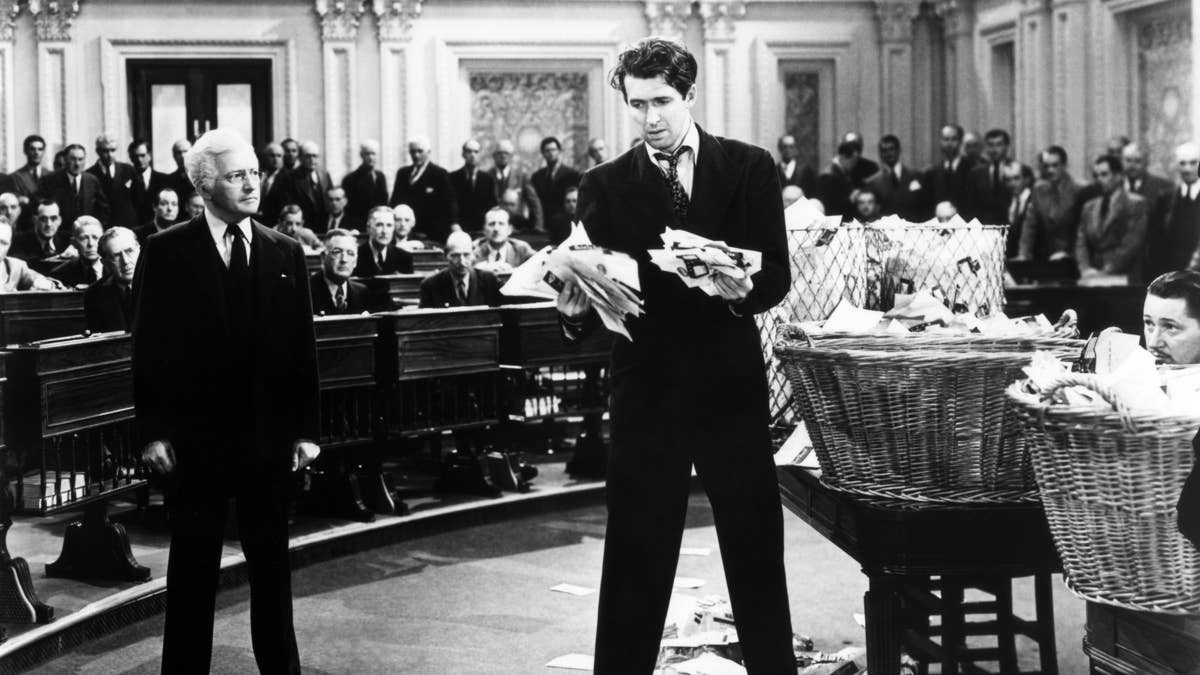
To reproduce the strained, increasingly ragged voice of a senator who refuses to stop speaking, Capra and his production team employed a method that would be difficult to justify under modern standards of occupational and medical safety: Stewart’s throat was periodically swabbed with mercuric chloride.
The American Film Institute’s catalog explicitly records the detail, stating that Capra and Stewart later revealed in interviews that Stewart’s throat was treated with mercuric chloride to produce the hoarseness required for the filibuster scenes. The Washington Post also documented the practice in its retrospective coverage of the film.
Mercuric chloride, also known as mercury(II) chloride, is a highly toxic mercury compound. It was used in this context to irritate the tissues of Stewart’s throat and produce the rough, strained vocal quality Capra wanted. The resulting sound helped communicate the physical deterioration of Jefferson Smith as his long speech wore on.
It shows Stewart was not merely required to deliver an emotional monologue. He had to make the audience believe that his character’s voice was approaching its limit. As the fictional senator continues speaking, his delivery becomes more strained, his body grows weary, and his determination appears increasingly difficult to sustain. The voice is an essential part of the scene’s dramatic progression.
Capra’s reported reasoning was that conventional acting alone could not fully reproduce the physical effect he sought. Accounts attributed to the director describe his conviction that genuine vocal strain would produce a more convincing performance than an actor simply pretending to be exhausted.
Some later accounts also mention bicarbonate of soda as part of the effort to dry out Stewart’s throat. That detail appears in retrospective film commentary, although the mercuric chloride treatment is the better-corroborated element in the American Film Institute’s account.
There is an important medical fact here: the treatment should not be confused with a harmless acting trick. Mercuric chloride is toxic, and deliberately exposing the throat to it would be considered an unacceptable way to induce vocal irritation under modern safety standards. The historical accounts establish that the practice was used, but they do not provide enough medical documentation to determine precisely how much exposure Stewart received or whether he suffered lasting injury from it.
The episode illustrates an era of filmmaking in which the pursuit of physical authenticity could take precedence over considerations that contemporary productions would be expected to address through safer methods. Such as William Friedkin‘s dangerous car chase scenes on real streets with real foot and motor traffic. It also reveals something about the scene’s construction: the apparent collapse of Smith’s voice was not solely a performance effect. The production reportedly sought to create the physical conditions that would help Stewart convey it.
Does that diminish Stewart’s acting? On the contrary, the treatment alone could not have supplied the scene’s emotional intelligence, timing, or escalating desperation. Stewart had to turn the vocal strain into a coherent portrait of a man whose body was failing while his conscience refused to yield.
The result is a performance in which the actor’s voice becomes a dramatic instrument. Every faltering phrase communicates both physical weakness and moral resolve. This effectively made Smith’s persistence increasingly moving as the scene approaches its climax.
Is Mr. Smith Goes to Washington the Greatest Political Drama of All Time?
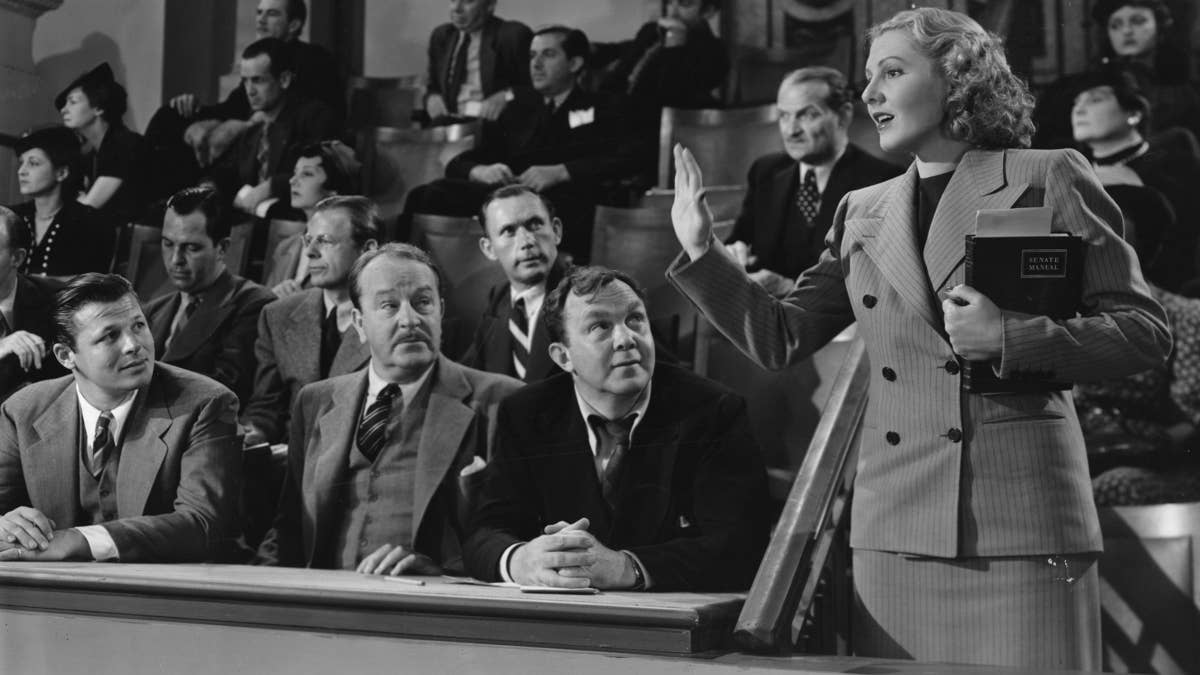
That’s ultimately a critical judgment rather than an objectively provable fact. Nevertheless, the film’s historical recognition, awards record, and enduring place in American film culture make it one of the strongest candidates for that crown.
The American Film Institute ranked the film No. 29 on its original 100 Years…100 Movies list, published in 1998, and No. 26 in its 10th-anniversary edition in 2007. The film also appears on AFI’s 100 Years…100 Cheers list of inspiring American movies, while Jefferson Smith was recognized among the institute’s most memorable screen heroes.
In 1989, the film was selected for the National Film Registry at the Library of Congress during the registry’s inaugural year. The registry preserves films considered culturally, historically or aesthetically significant, placing Capra’s work among the motion pictures judged worthy of long-term national preservation.
According to Sony Pictures Entertainment, the film received 11 Oscar nominations for the 1939 film year, including Best Picture, Best Director, and Best Actor for Stewart. It won one award, for Best Motion Picture Story, credited to Lewis R. Foster. The Academy’s official records confirm the win and the nominations for Stewart, Capra, and other members of the production.
Mr. Smith’s achievement was not simply that it portrayed corruption convincingly. The film made a compelling argument that political idealism need not be synonymous with political ignorance. Smith begins as an inexperienced outsider, but his faith in public service exposes the cynicism of those who have learned to treat government as a means of private enrichment.
That argument remains relevant because the film refuses to equate patriotism with unquestioning loyalty to those in power. Smith’s love of his country compels him to challenge officials who betray its democratic principles. His filibuster becomes an act of resistance rooted in the belief that the institutions of government belong to the public, not to political bosses.
Other films, including All the President’s Men, The Manchurian Candidate and Network, offer darker or more skeptical examinations of political power. Yet Capra’s film occupies a distinctive position because it combines institutional criticism with an unabashed belief in the possibility of democratic renewal.
On October 17, 2026, the film’s Washington premiere marks its 87th anniversary.
from Men's Journal https://ift.tt/w0pDlUG
via IFTTT