

If you’re reading this, you’re already going to the gym a few times a week, lifting weights, and—uh—eating your veggies. (Your mom would be so proud.) Bottom line: You’re doing all the big things right, and that’s commendable. But the crazy thing is that there could still be a key mistake you’re overlooking with your workoutitself that’s hurting your progress.
While most advice focuses entirely on which movements to pick, everyone forgets about the setup. The order of your exercises matters just as much as the exercises themselves. If you are just walking into a crowded gym and tackling your routine at random based on whatever bench happens to be open, you are likely stalling your own progress.
Why Your Workout Order Matters Much More Than You Think
“Properly ordering your exercises can significantly improve performance, function, and longevity,” says Matt Kasee, MS, CSCS, owner of Trilogy Fitness Systems in Cincinnati, Ohio. The problem for a lot of guys, however, is that they get to the gym and do what they feel like doing first. (Or they do whatever’s available, especially if the gym is super crowded.)
But there are downsides to that. “If we do a big compound exercise, like squats, in a fatigued state, we won't be able to produce as much force for maximal results,” Kasee explains. “You will also be more likely to experience a break in form and increase your risk of injury.”
On the other hand, reordering your exercises can help boost your progress. In a study in the European Journal of Sport Science, researchers found that you get the biggest increases in muscular strength with the exercises you do at the beginning of a workout.
That’s why it’s a best practice to do exercises that need precise technique and high muscle output early in a workout — after your warmup — before fatigue becomes a negative factor. That way, you have the most strength and technique available when you’re “fresh.”
Of course, every person is different, and there are times you might need to adjust your exercise order for your specific situation. For example, if you’re an older lifter or training around an injury, you might actually benefit from doing an exercise a tiny bit later in your workout.
“For example, for a bench press, you might do a back exercise first to help get more blood flow into supporting muscles around your shoulders to help support the primary movement,” Kasee explains.
Related: The Absolute Best Workout Routine for Men, According to Science
How to Build the Ultimate High-Performance Workout
Read on for the best practices when ordering your exercises. And no matter what, always do a thorough warmup beforehand to open your joints and muscles, raise your core temperature, get your blood flowing, and activate your mind and body so that it’s ready to move some weight.
Explosive Power and Speed Training Exercises
High-speed, fast-twitch, and very technical exercises like Olympic lifts always go first: You need all your motor units and mental energy available when you perform them.
This also includes your plyometric drills, which are explosive exercises that target both your fast-twitch fibers as well as your “stretch-shortening cycle” (i.e., the rubber band effect you get from quickly loading a body part and exploding from that contraction).
Exercises like box jumps, hops, and bounds are not only fast-twitch and explosive, but they can actually prime your body to move more weight because you’re activating your nervous system and muscles with something called “post-activation potentiation.”
Heavy Barbell Exercises and Powerlifts
The more muscle groups an exercise targets, the earlier it should go. This is where you’d do things like your deadlift and bench press. For example, the back squat recruits damn-near every muscle in your body, so it should normally be numero uno.
If you usually don’t do your powerlifts this early in a workout, then congratulations— you’re about to change your life for the better.
Next, aim to order your exercises from heaviest to lightest. For example, if you have a barbell bench press and a chest flye, do the bench first because you’ll be using far more weight and you need full muscle recruitment to move the most weight (and move it safely).
Another thing that can help is arranging your exercises into supersets that target different areas of your body. That way, you can do more exercises in less time while still giving those body parts ample rest.
Accessory Lifts and Targeted Core Exercises
Once you finish all of your “main” lifts, then you can have dessert and focus on your isolation moves that target one muscle (i.e., your arm exercises): Triceps cable rows, bicep curls, hammer curls, skullcrushers, forearms, calves, deltoids, etc.
This is also a perfect time for core-specific training (separate from the core activation exercises that you should already be doing in your warmup). Exercises like planks, Paloff presses, stability ball exercises, ab wheel rollouts, and weighted carries go here.
High Intensity Conditioning Workout Finishers
If you’re looking to burn a little extra flab before you hit the showers or go home, this is it. You’ve already smoked all your muscles—now, it’s time to smoke your cardiovascular system with high-intensity intervals like battle ropes, jump ropes, crawls, stationary rows, etc.
But no matter what, once you finish your workout, do a proper cool down. Stretch your muscles, use a foam roller, slow your heart rate down, and get some proper post-workout nutrition.
A Step-by-Step Sample Workout for Serious Performance
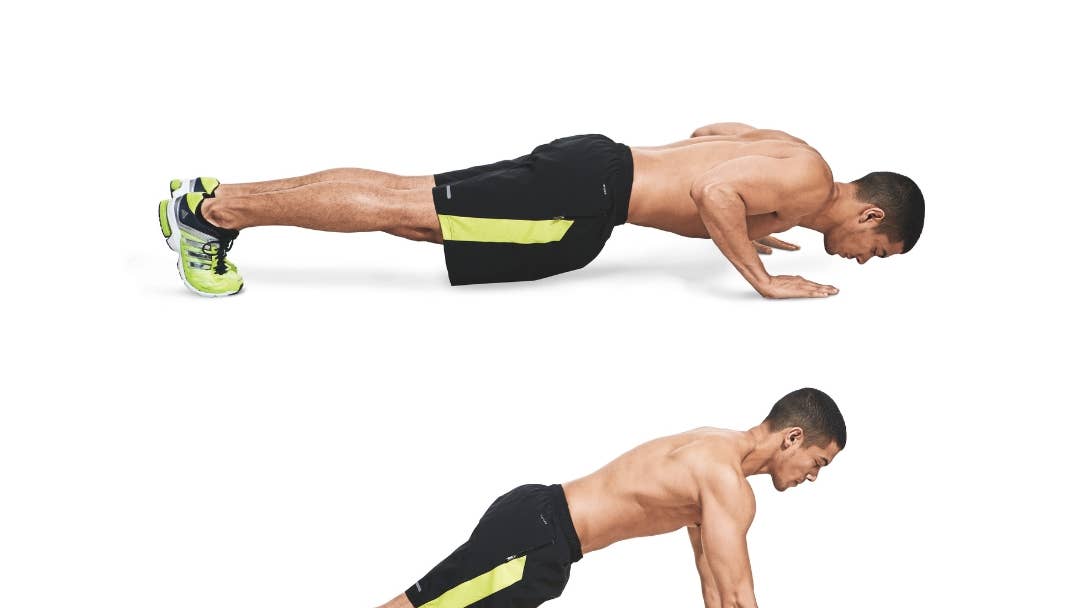
A1) How to Do Plyo Pushups
Beth Bischoff
- Perform a standard pushup, but explode from the bottom position until your hands completely leave the ground.
- Attempt to get maximum height off the ground.
- Cushion your landing and repeat for 15 seconds straight.
- Perform 3 of 5 reps, resting 60 seconds between sets.
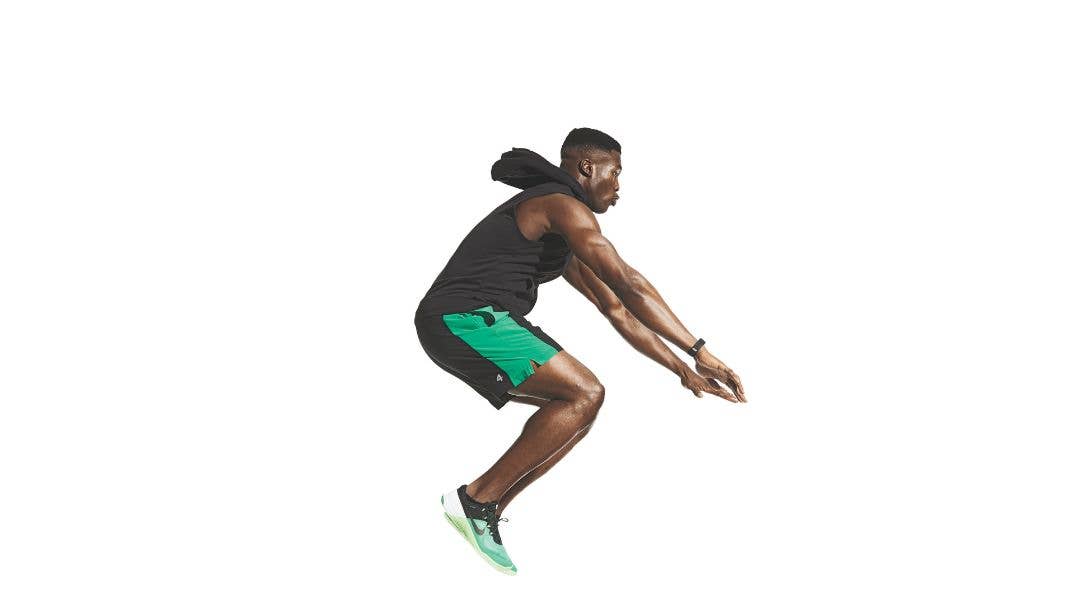
A2) How to Do Box Jumps
James Michelfelder
- Start from a standstill position on the ground.
- Squat down, then explode up to a box (or bench).
- Land softly on the top of the box, then step down easily to avoid stress on the knees and low back.
- Perform 3 of 5 reps, resting 60 seconds between sets.
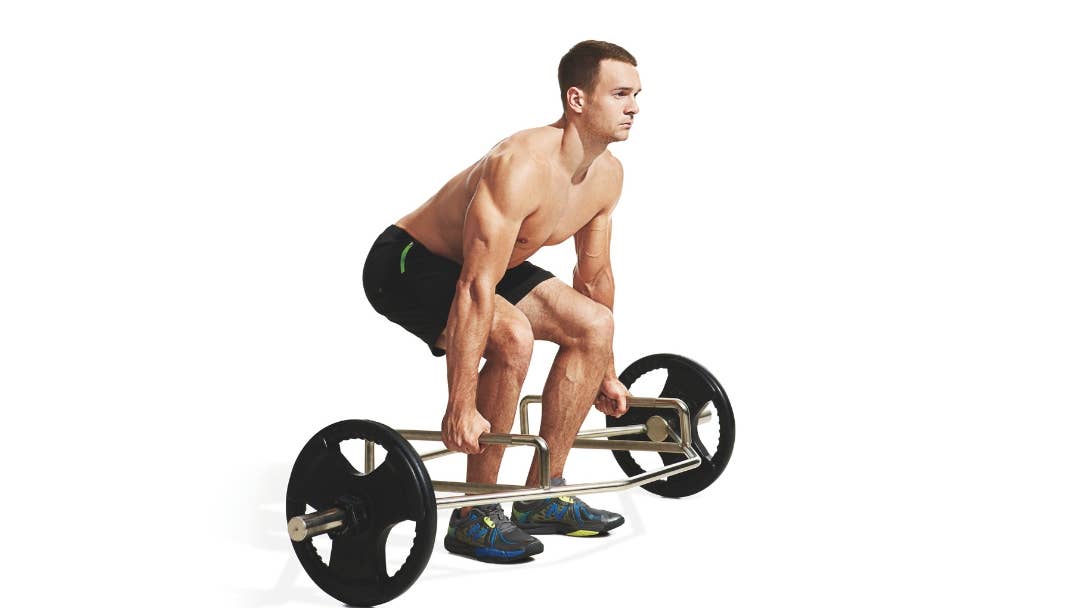
B1) How to Do Trap Bar Deadlifts
Beth Biscohff
- Standing in the center of a trap bar, bend your hips back to grasp the bar’s handles with both hands.
- Keeping your lower back in its natural arch and your chest facing forward, drive through your heels to lift the bar off the floor and lock out your hips.
- Make sure to keep the bar close to your body throughout the movement.
- Perform several warmup sets, increasing the weight gradually until you reach your desired weight.
- Perform 4 of 8 reps, resting 60 seconds between sets.
B2) How to Do Dumbbell Neutral Grip Bench Press
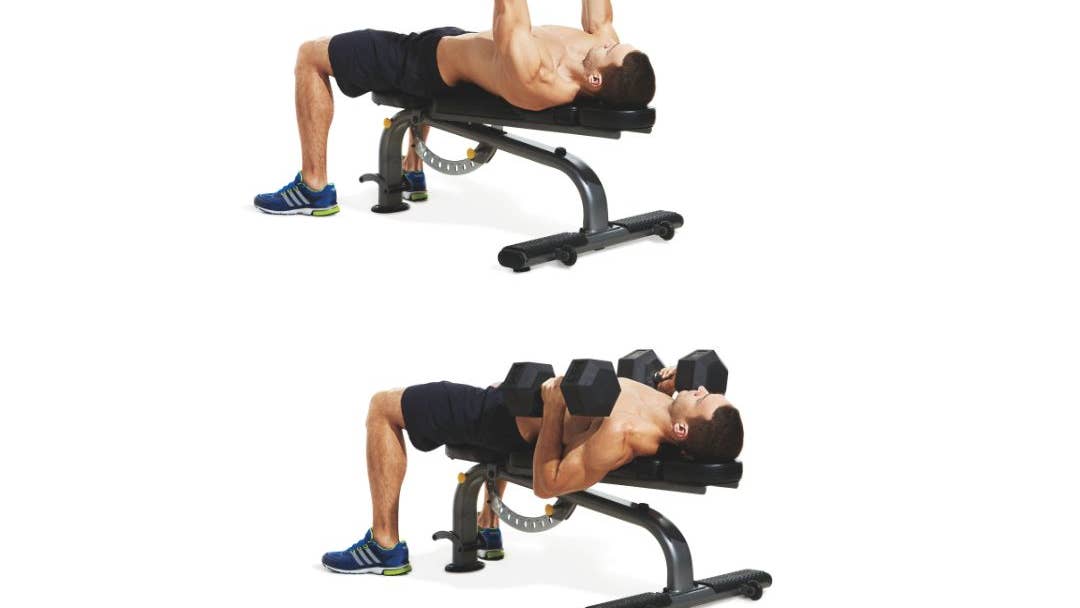
- Lie on a flat bench, holding dumbbells at your chest.
- Slowly extend your arms so dumbbells are in a bench press position.
- Lower the weights with control until elbows hit about a 45-degree angle from your torso.
- When reach that end point, extend arms to the starting position.
- Perform 4 of 8 reps, resting 60 seconds between sets.
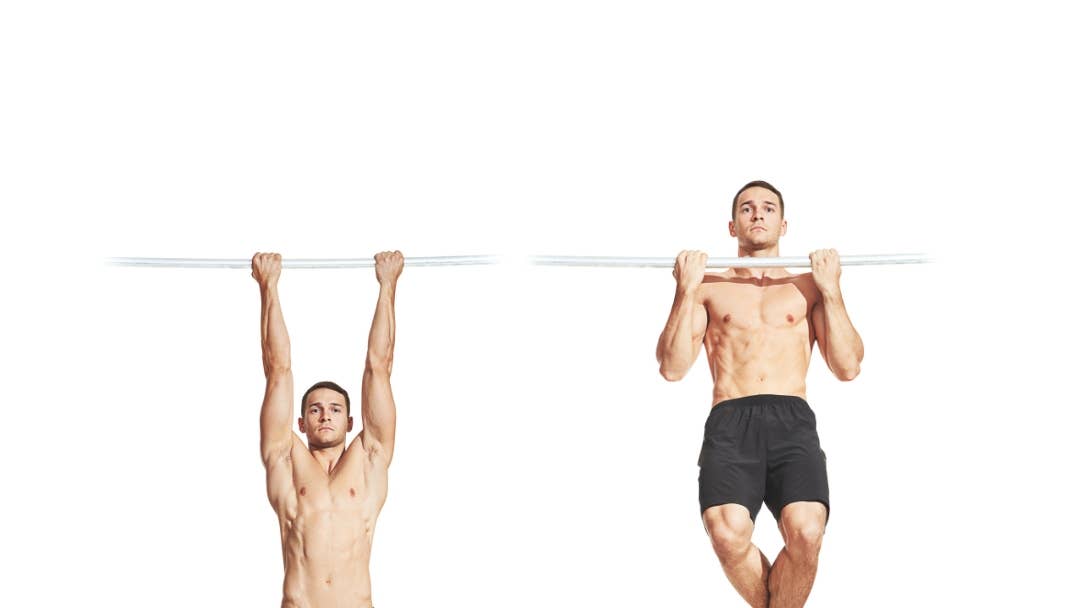
B3) How to Perform Chinups
Beth Bischoff
- Begin in a hanging position with hands facing each other.
- Focus on pulling the shoulder blades together and down as you pull yourself up.
- The rep doesn’t count until the shoulders are at least at hand level.
- Squeeze at the top for a one count before lowering back to the start with fully extended elbows.
- Use band assistance if needed or increase the difficulty by slowing the tempo of the downward movement.
- Perform 4 of 8 reps, resting 60 seconds between sets.
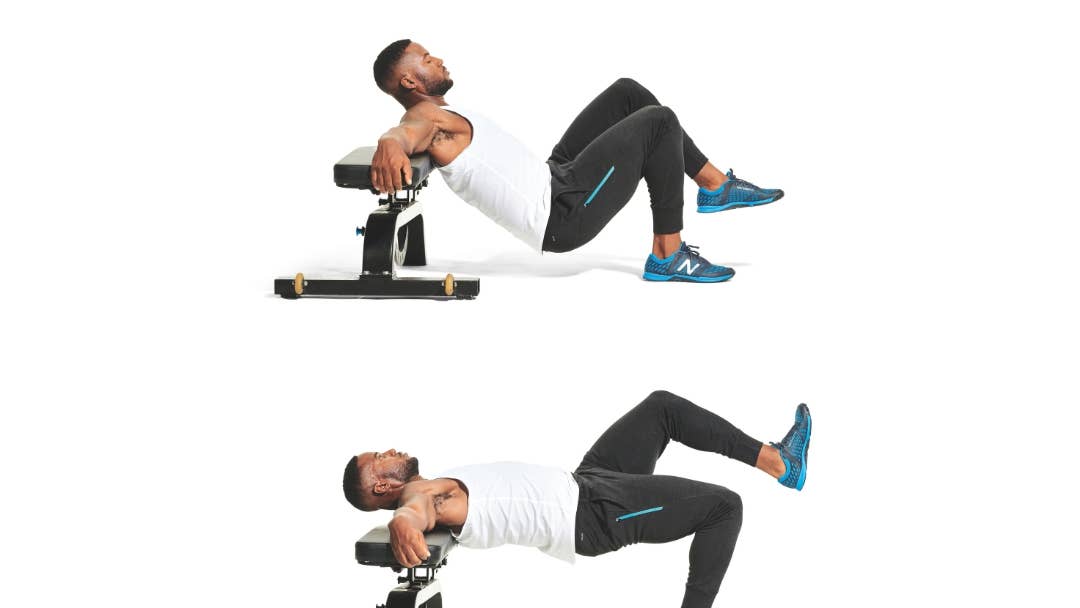
C1) How to Do Single-Leg Hip Thrust
James Michelfelder
- Sit on the ground with your upper back against a bench and one foot planted on the floor, to start.
- Lift your other leg off the ground, bend at the knee, and place a dumbbell across your hips (advanced).
- Drive through the heel of your grounded foot to lift your hips until your torso is in line with your thigh.
- Lower back down slowly and repeat all reps on one side before switching legs.
- Perform 3 of 10 reps, resting 60 seconds between sets.
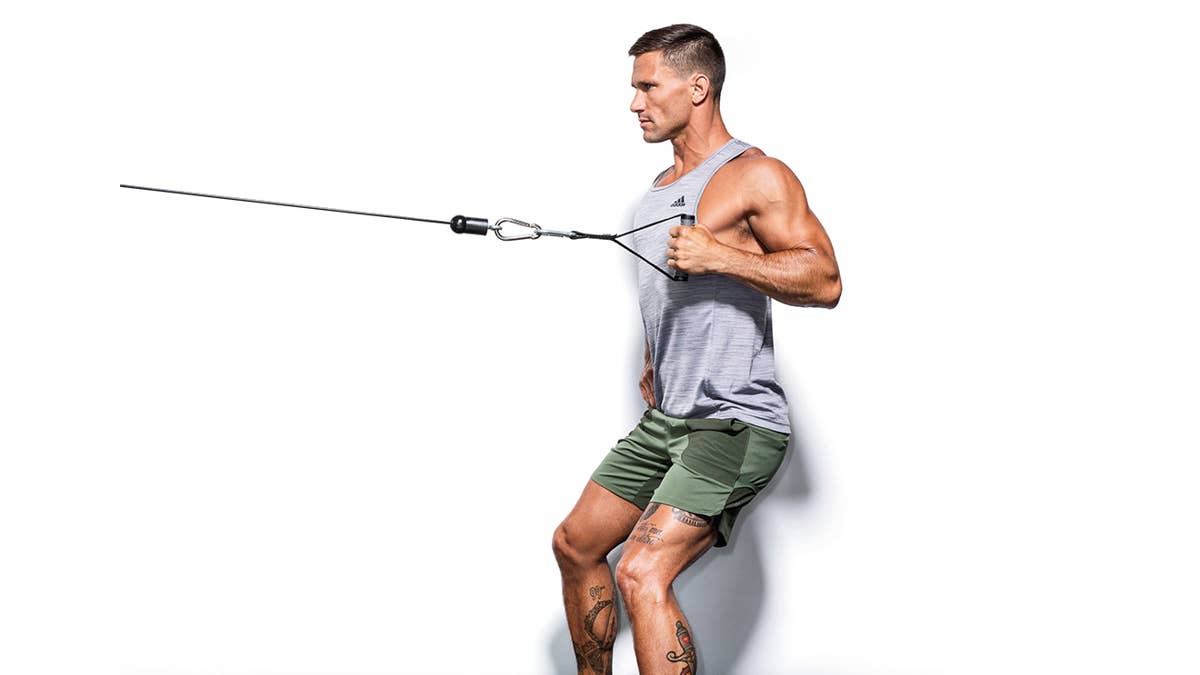
C2) How to Do Single-Arm Cable Rows
Ian Maddox
- Stand facing the pulley and hold the D-handle in your left hand with the palm facing down.
- Step back until cable is taut.
- Then sink back into your butt and keep your chest high, with your right hand on right hip.
- Retract your shoulder blades and draw your elbow straight back.
- As you pull, rotate your palm toward your body, so it’s next to rib cage.
- Perform 3 of 10 reps, resting 60 seconds between sets.
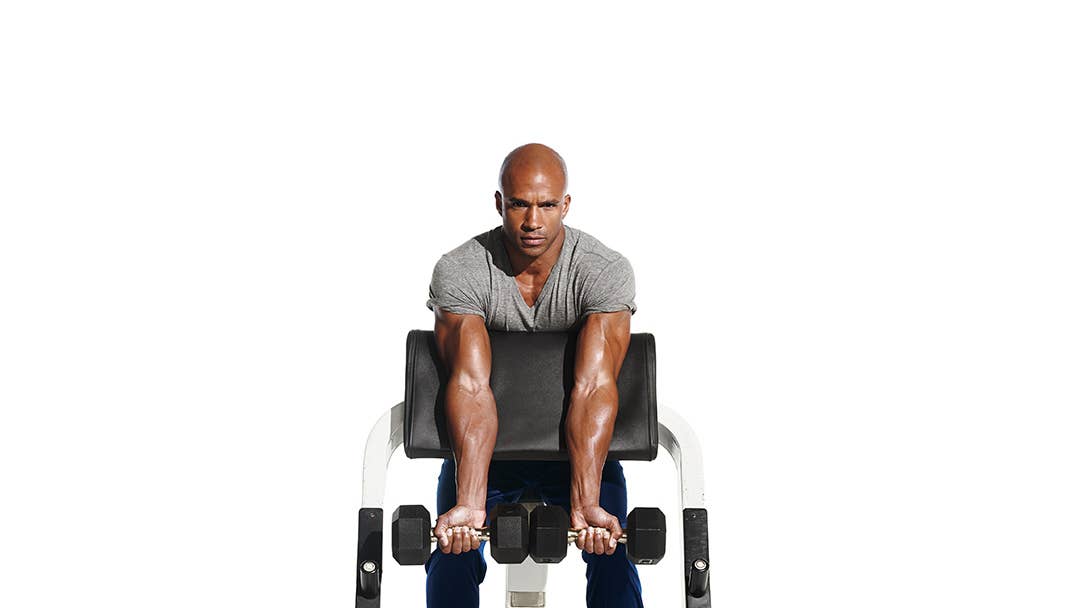
D1) How to Do Preacher Curls
James Michelfelder & Therese Sommerseth
- Using a regular preacher bench, grab an EZ Curl bar or dumbbells with both hands using an underhand grip (palms facing upwards).
- Slowly curl the bar up to the top and bring it a few inches from your chin.
- Return the weight back down with a slow and controlled tempo to the starting position, allowing some resistance (negative) on the way back down.
- Perform 3 of 15 reps, without resting between sets.
D2) How to Do Tricep Rope Pulldowns
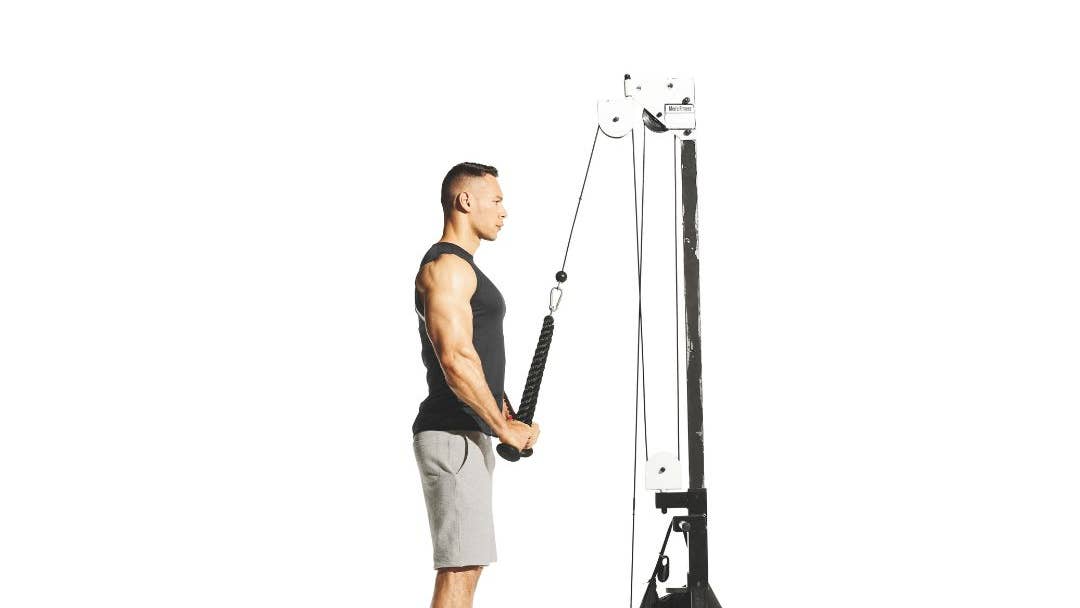
- Stand facing a cable machine with a straight bar or rope attached to a high pulley.
- Keep your elbows tucked close to your sides and grip the attachment with palms facing down.
- Push the handle down until your arms are fully extended. Squeeze the triceps at the bottom.
- Perform 3 of 15 reps, resting 60 seconds between sets.
Finisher: Airdyne Bike Sprints, Sets: 8 to 10, 15 seconds on / 45 seconds off
from Men's Journal https://ift.tt/vBe4pWV
via IFTTT